Make Money with AI-Powered Legal Practice Automation
How AI-Powered Legal Practice Automation Multiplies Solo Firm Output (And the Billing Problem It Creates)
Most AI automation content focuses on cutting hours from administrative work. For legal professionals, especially those running a Solo Practice, the real opportunity lies in what happens when you reclaim those hours: the ability to serve more clients, take on pro bono or discounted work, and scale your impact without hiring additional staff. But this shift also exposes a long-unquestioned flaw in traditional legal billing that forward-thinking practitioners are now racing to solve.
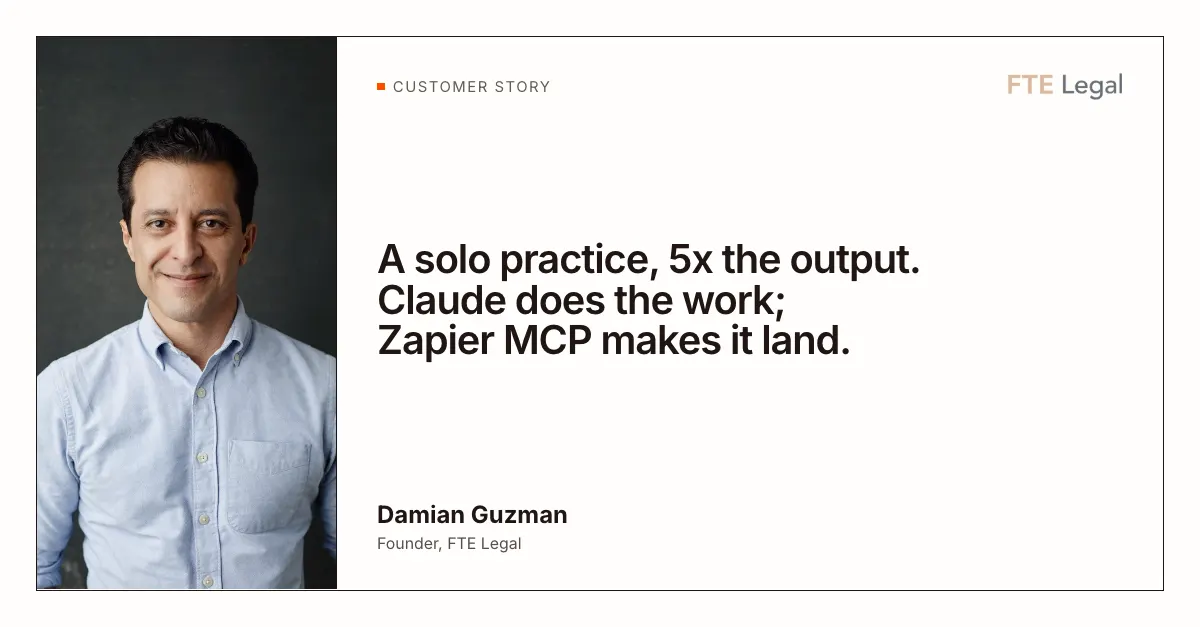
The 5x Output Solo Practice Built on LLM Agents and Connected Tools
Damian Guzman, founder of FTE Legal, a Social Purpose Corporation based in Oakland, California, runs a practice that represents small businesses and fintechs, often charging rates below market and halved again for early-stage clients who cannot yet pay full freight. He caps his self-imposed billable hours at 30 per week, meaning every hour spent on admin is an hour he cannot dedicate to client work.
Since summer 2023, Damian has rebuilt that math with Claude, and expanded his setup in April 2024 with Zapier MCP to connect his core tools. The result is a solo practice that produces roughly five times as much output as it did just a few months prior, with no additional hires.
The Pre-Inbox Workflow That Runs on Autopilot
The core of Damian’s system is an hourly scan that runs before he opens his email: Claude checks his Gmail for any actionable requests from clients, logs the task in Clio (his system of record), and gets to work on the request directly. It drafts NDAs, completes first-pass contract reviews, and marks up language in track changes. By the time Damian opens the client email, roughly half of the requested work is already finished.
This flagship workflow is just one piece of a much larger agentic setup. A daily calendar scan replaces Google Meet links with Zoom for all meetings in the next two weeks, automatically skipping any events with a physical address attached. A 48-hour buffer blocks time ahead of all client meetings so he never walks into a call cold. Regulatory alerts land in his inbox daily, with a weekly rollup sent to his Slack workspace. A dedicated docket monitor tracks two personal legal matters, and a separate automation strips party names out of Clio’s billing narratives for privacy-sensitive clients before any AI ever touches the time entries.
How Zapier MCP Fills the Gaps Native AI Integrations Miss
Before MCP protocols became widely available, connecting an LLM agent to a specific business tool required either a pre-built native integration that may not support your use case, or custom development that could take weeks and cost thousands of dollars. Damian’s setup is a perfect case study for this gap: Claude’s native Gmail connector could not handle scheduled sends, so he moved that piece of his workflow to Zapier MCP. When Claude’s GitHub connector broke due to an OAuth conflict while an Anthropic support ticket sat open, Zapier substituted in seamlessly without him waiting on a vendor’s timeline.
The pattern he uses is simple: start with the tools Claude connects to natively for core tasks, and use Zapier MCP to close any gaps without a full rebuild. This eliminates the need for custom code, a huge win for solo practitioners who do not have dedicated IT or development staff to support their automation efforts.
The Unintended Problem High-Productivity Solo Practices Create
Damian estimates he now completes the same volume of work in 20% of the time it used to take, a 5x jump in Productivity that most automation content would frame as a final win. But Damian does not stop there, because he bills by the hour.
If a task that used to take five hours now takes one, and he maintains his hourly rate, his revenue for that task drops by 80%. If he raises his rates to compensate, he risks pricing out the early-stage clients his Social Purpose Corporation is designed to serve. This is the problem he is now building a new company to solve: once an LLM agent can do the work of a full legal team, how do clients know what that work is actually worth?
This is not a problem unique to Damian. As more legal professionals adopt LegalTech tools powered by AI automation, the traditional time-based billing model that has governed the industry for decades is becoming obsolete. For solo practices, this is both a major risk and a unique opportunity: the practitioners who adapt their pricing models first will be able to capture the full value of their increased output, rather than leaving money on the table because their billing structure has not kept up with their new capabilities.
Actionable Steps for Legal Pros Looking to Adopt AI Automation
- Start with high-friction admin tasks first: Map your weekly workflow to identify the non-billable tasks that take up the most time—client intake, calendar scheduling, contract drafting, regulatory monitoring. These are the easiest tasks to hand off to LLM agents, and they deliver the fastest productivity gains for solo practices with limited bandwidth.
- Use MCP protocols to avoid custom builds: If your preferred LLM tool does not have a native integration with your core legal tools (like Clio, Xero, or Zoom), look for MCP-compatible middleware like Zapier MCP to connect them without hiring a developer or waiting for vendor support. This lets you build a custom agentic workflow in hours, not weeks.
- Test alternative billing models alongside automation: Before you roll out AI automation across your entire practice, run a small pilot with a few clients using flat-fee or value-based billing for tasks that AI will handle. This lets you capture the full value of your increased output without undercharging for work that now takes a fraction of the time.
- Leverage existing LegalTech platforms for turnkey solutions: If you do not want to build a custom agent stack from scratch, platforms like Upwork have vetted LegalTech specialists who can set up pre-built AI automation workflows for solo practices, and marketplaces like Gumroad offer pre-trained LLM agent tools for contract review, client intake, and docket monitoring that work out of the box.
For Damian, the shift to AI-powered automation did not just cut his admin time—it forced him to rethink the core value his practice delivers. As more solo legal professionals adopt similar AI Automation stacks, the firms that move fastest to align their pricing with their increased output will be the ones that thrive, rather than getting left behind by outdated billing models that no longer reflect the work LLM agents can handle.