Make Money with B2B Lead Scoring and Person Enrichment APIs
Why Standard Lead Data Fails B2B SaaS Teams
The response immediately tells you the lead’s name is Hein Dueck, his short bio notes he builds AI-powered outbound systems for recruitment agencies, and his LinkedIn URL is available for further enrichment. Most API providers let you test endpoints directly from their dashboard, and offer copy-paste code snippets for Python and Node.js environments if you want to build custom integrations for your workflow.
Next, you pass that LinkedIn URL to the Person Enrichment API, which returns a full profile: Hein is the Founder of Kestrel System, his skills include AI-powered automation and lead response time reduction, and his work history confirms he leads product development for recruitment agency tools. That single enrichment call tells you he is a high-intent decision-maker at a company that aligns perfectly with your target customer profile—no manual LinkedIn research required.
Building a Lead Scoring Model with Enriched Data
Once you have full professional context for every lead, you can build a data-driven lead scoring system that prioritizes high-value prospects automatically. Lead scoring assigns point values to different lead attributes to rank them by likelihood to convert, so your sales team can focus on the hottest leads first.
A basic B2B SaaS lead scoring model using enriched data might look like this:
- Role-based scoring (40% of total score): C-suite executives and founders get 30 points, department heads get 20, managers get 15, individual contributors get 5, and interns or students get 0.
- Company fit scoring (30% of total score): Leads from companies in your target industry get 20 points, companies with 50+ employees get 15, companies in your target geographic region get 10, and leads from competitor companies get 0.
- Intent signal scoring (20% of total score): Leads who signed up for a demo request instead of a newsletter get 15 points, leads whose bio or recent social posts mention pain points your product solves get 10, and leads who visited your pricing page get 5.
- Engagement scoring (10% of total score): Leads who opened 3+ marketing emails get 5 points, leads who downloaded a whitepaper get 3, and leads who attended a live webinar get 2.
Automating Enrichment and Scoring for Scale
Manually running API calls and updating lead scores for every signup is not sustainable for teams with high lead volume. This is where automation comes in: you can build a no-code or low-code workflow that enriches every new lead, calculates their score, and updates your CRM in real time, no manual work required.
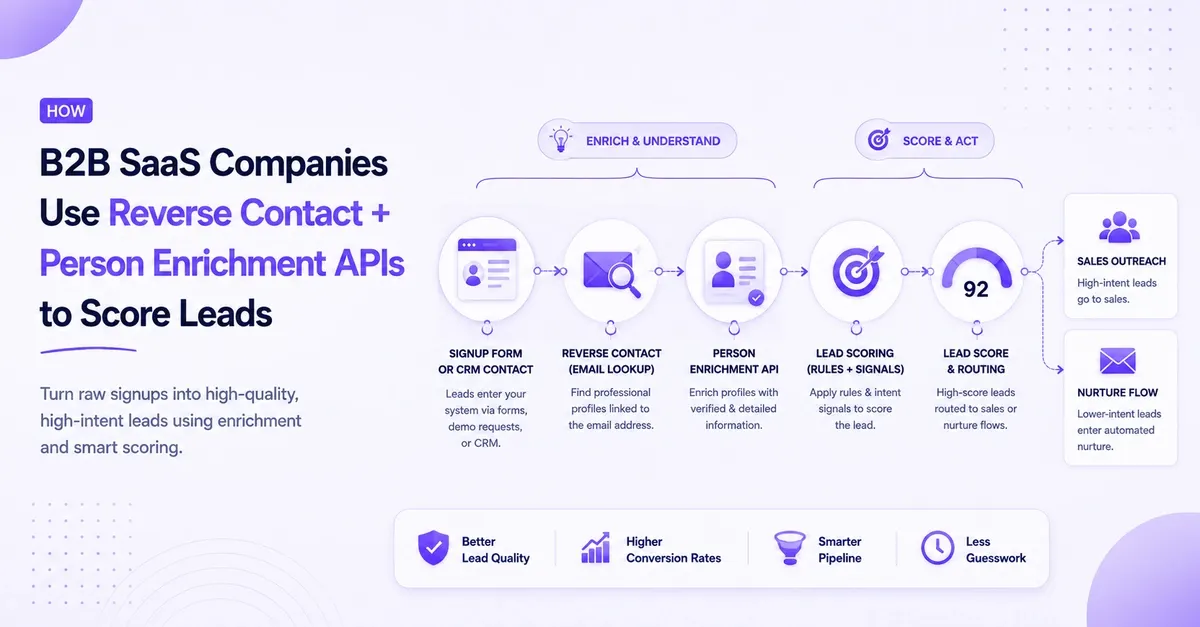
To set up this automation, you can use tools like Zapier, Make, or n8n to connect your signup form, API tools, and CRM. The workflow runs as follows:
- When a new lead submits your signup form, the workflow triggers automatically.
- The workflow calls the Reverse Email Lookup API with the lead’s submitted email address to pull their name, bio, and LinkedIn URL.
- It then passes the LinkedIn URL to the Person Enrichment API to pull full professional context.
- The workflow runs the enriched data through your pre-built lead scoring ruleset to calculate the lead’s total score and tier.
- It automatically updates the lead’s record in your CRM (HubSpot, Salesforce, Pipedrive, etc.) with their score, tier, and all enriched data, and assigns hot leads to a sales rep for immediate follow-up.
This end-to-end automation cuts down hours of manual data entry and research every week, ensures no high-value leads are missed, and keeps your CRM data clean and up to date without any extra work from your team. Many B2B SaaS teams also use this enriched data to personalize outreach, referencing a lead’s recent work project or listed skills in sales emails to boost response rates by 20% or more.
Monetizing API-Powered Lead Scoring as a Service
If you’re a freelancer or agency owner, mastering this workflow is a high-income skill with massive demand from B2B SaaS teams that don’t have the technical bandwidth to build it in-house. You can sell this service on major freelance platforms, or create digital products to sell passively:
- Freelance service gigs: Post listings on Upwork, Fiverr, and LinkedIn offering “B2B lead scoring setup with automated data enrichment” or “CRM enrichment workflow automation”. Most B2B SaaS teams will pay $500 to $2,000 for a one-time setup, plus $100 to $300 per month for ongoing maintenance and optimization. Experienced providers charge upwards of $5,000 for enterprise setups with custom integrations.
- Digital products on Gumroad: Sell pre-built lead scoring workflow templates, video courses teaching other freelancers how to build these integrations, or even a curated list of vetted enrichment APIs for B2B SaaS teams. A basic workflow template can sell for $29 to $99, while a full video course can be priced at $49 to $199, with zero ongoing work required after you create the product.
- Retainer services: Offer ongoing lead scoring optimization, CRM data cleaning, and enrichment workflow maintenance to B2B SaaS clients for a monthly retainer of $1,000 to $5,000 per client, depending on the size of their lead volume.
Top providers in this niche make $3,000 to $10,000 per month part-time, as the ROI for B2B SaaS clients is extremely high: most recoup the cost of the service in added revenue from converted leads within the first 30 days.
Key Tools to Get Started
You don’t need expensive tools to test this workflow. Most enrichment API providers offer free tiers for low-volume testing, so you can build a proof of concept for a client with zero upfront cost. Common tools to use include:
- Reverse email lookup APIs: Hunter, Snov.io, Clearbit
- Person enrichment APIs: Apollo, Lusha, Proxycurl
- Automation tools: Zapier, Make, n8n
- CRM platforms: HubSpot, Pipedrive, Salesforce
For custom integrations, most providers offer SDKs for Python and Node.js, so you can build tailored workflows for clients with specific needs.
For B2B SaaS teams, data is the single biggest competitive advantage in lead generation. Using person enrichment APIs to power your lead scoring eliminates guesswork, prioritizes high-value leads, and automates busywork so your sales team can focus on closing deals. For freelancers and agency owners, this is a low-barrier, high-demand skill that opens up multiple revenue streams, from freelance services to passive digital product sales. Whether you’re looking to improve your own B2B SaaS’s conversion rates or build a new income stream, mastering API-powered lead scoring and data enrichment is a high-impact investment.