Build an AI Video Clipping SaaS (Katto) to Earn with AI
The Reality Check Every Solo Founder Faces When Building an AI SaaS
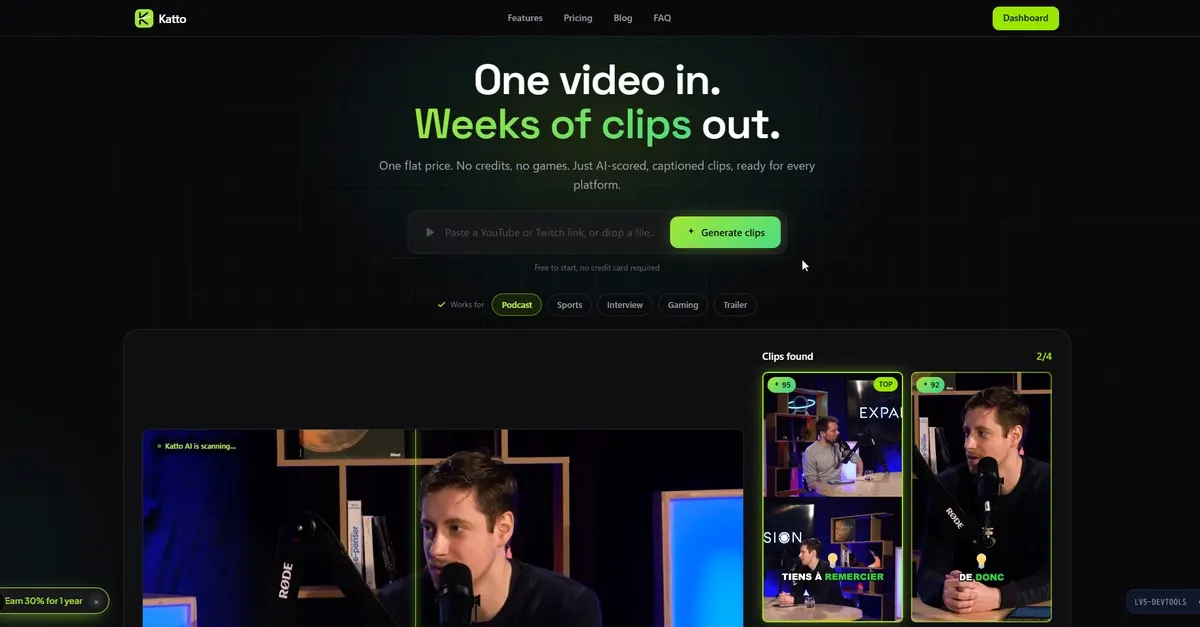
Building an AI SaaS product as a solo founder often feels like shouting into a void. You spend months perfecting the technology, but the real battle begins when you try to get people to actually use it. I learned this lesson the hard way while building Katto, an AI tool that turns long-form content into ready-to-post vertical clips. The journey exposed two critical distribution challenges that nearly killed the project before it started: invisible technical failures and total AI invisibility.
Why Organic Growth Metrics Can Be Deceptive
It was a slow Tuesday morning. I stared at the real-time analytics dashboard, convinced the product was dead. Signups had flatlined. The panic was real. Then I stopped watching the live counter and actually read the aggregate data.
The database told a different story: 129 total users, with 58 joining in the last seven days. All organic. Zero ad spend.
That wasn't a dead product. That was a product with traction that I couldn't see because I was obsessing over hourly fluctuations instead of weekly trends. But the numbers also hid two silent leaks that were quietly undoing every bit of momentum that organic growth brought in.
Leak One: The Silent Killer — Download Failures
The first gut punch came when I segmented the job success rates. On a recent day, nearly six out of ten processing jobs failed. For a video clipping tool, that is catastrophic.
I dug into the error logs instead of panicking. The failures split cleanly into two categories:
- YouTube Bot Wall (approx. 50%): The downloader choked on YouTube anti-bot measures. A user pastes a link, the video never downloads, the job dies.
- Plan Limit Enforcement (approx. 50%): Free-tier users uploading videos longer than the allowed cap hit a hard wall.
The second category is actually a positive signal — users are showing up with real, long-form content and hitting a ceiling. That is a pricing and packaging problem to solve later. The first category, however, is a pure infrastructure bug. And it is the most dangerous kind: invisible to the founder, fatal to the user.
I spent an unglamorous day migrating the backend infrastructure to handle the download layer more robustly. I didn't take the fix on faith. I pulled exact timestamps to verify. The last download failure logged was the day before the migration; there have been zero since. Boring work, yes. But the gap between a user who stays and a user who churns often lives in exactly this kind of plumbing.
Leak Two: The Visibility Void — You Do Not Exist to the Recommenders
Fixing the pipeline stopped the bleeding, but it didn't solve the oxygen problem. I opened Google Search Console. The site ranks on page two or three for almost every relevant keyword. My own brand name ranks around position 28 because "katto" is a common dictionary word, and I haven't earned the authority to own it yet. Interestingly, "katto ai" ranks near the top, which signals exactly which brand variant I need to lean into.
Then I ran the test that actually matters in 2025 and beyond. I asked ChatGPT: "What are the best AI clipping tools?"
It confidently listed ten competitors. Katto was not on the list. I rephrased the prompt three different ways. Same result. The large language models that a rapidly growing share of potential users now trust for software recommendations have absolutely no idea this product exists.
That realization stung more than the 60% failure rate. You can fix a download script in an afternoon. You cannot fix "the AI doesn't know you exist" in an afternoon.
Strategic Pivot: Treating LLMs as a Primary Acquisition Channel
If ChatGPT, Perplexity, and Gemini are becoming the new front page of the internet, then LLM optimization is the new SEO. I am now treating "getting mentioned by the model" as a core KPI, right alongside signups and MRR.
Here is the tactical playbook I am executing to force visibility into the training data and retrieval systems:
1. Seed the "Best Of" Lists on High-Authority Domains
Models retrieve from the live web (RAG) and rely on training data snapshots. I need to exist on the pages the models cite. I am targeting listicles on sites like G2, Capterra, Product Hunt, and reputable tech blogs (e.g., TechCrunch, The Verge AI sections). A mention in a "Top 10 AI Video Tools 2025" article on a DR80+ domain is worth more than ten backlinks from low-quality directories.
2. Create "Entity-Defining" Content Assets
I am publishing definitive, structured content on the Katto blog that answers the exact queries users ask LLMs:
- "How to clip long YouTube videos for Shorts/TikTok/Reels automatically"
- "Best aspect ratio settings for viral vertical video in 2025"
- "Katto vs. OpusClip vs. Vidyo.ai: Feature comparison matrix"
Schema markup (Article, Product, FAQPage) is non-negotiable here. I want the crawler to extract clean entities: Product Name: Katto, Category: AI Video Clipping, Key Feature: Auto-reframing.
3. Leverage User-Generated Proof on Community Platforms
Reddit threads (r/VideoEditing, r/SaaS, r/ArtificialIntelligence), Hacker News Show HN posts, and Indie Hackers product pages are heavily weighted in training corpora. I am documenting the build publicly — the failures, the infrastructure migraations, the revenue numbers. Authentic founder narratives get upvoted, indexed, and eventually ingested.
4. Structure the Product for "Tool Calling" Readiness
This is the long bet. As agents (OpenAI Assistants, LangChain chains, Zapier Central) start performing tasks for users, they need APIs they can call reliably. I am exposing a clean, documented REST API with OpenAPI specs early. If an agent can say "Clip this 2-hour podcast into 5 viral shorts" and hit my endpoint successfully, Katto becomes infrastructure, not just a destination.
The Economics of a Pre-Launch AI Tool
Currently, Katto is pre-revenue. The 129 users are on a generous free tier while I stabilize the infrastructure and nail the output quality. The monetization model is straightforward usage-based SaaS pricing:
- Starter (Free): 30 minutes of upload/month, 720p export, watermark.
- Pro ($29/mo): 300 minutes, 1080p, no watermark, API access, priority queue.
- Agency ($99/mo): 1200 minutes, 4K export, team seats, white-label options.
The math is simple: I need roughly 35 Pro subscribers to hit $1,000 MRR. With 58 signups in the last week alone, that target is achievable if the activation rate holds and the churn leaks stay plugged.
Activation Funnel Focus
I am currently instrumenting the funnel to answer three questions:
- What percentage of signups complete their first successful clip? (Target: >40%)
- What percentage of successful first-clippers return within 7 days? (Target: >25%)
- What is the free-to-paid conversion rate at Day 14? (Target: >5%)
If the download fix holds, the top-of-funnel conversion should jump immediately. The rest is product quality and onboarding flow.
Distribution Is a Product Feature, Not a Marketing Afterthought
The biggest mistake I made was treating distribution as something I would "do later" after the product was perfect. In 2025, for an AI SaaS, distribution is the product.
- Reliability is a distribution feature (users share tools that work; they warn others about tools that fail).
- API Access is a distribution feature (it unlocks integration marketplaces like Make, Zapier, n8n).
- Brand Disambiguation is a distribution feature (owning "katto ai" vs fighting for "katto").
- LLM Visibility is a distribution feature (the new organic search).
I am not buying ads. I am not cold emailing. I am fixing the pipes so the water doesn't leak, and I am planting flags on the map so the new cartographers (the LLMs) draw me in.
Key Takeaways for Founders in the Trenches
If you are building alone, watch for these two silent killers:
- Silent Technical Failure: Instrument every critical path. If the "happy path" (Upload -> Process -> Download) breaks, you lose the user forever. They will not tell you. You must know before they do.
- Semantic Invisibility: Check your entity presence in the major LLMs monthly. Ask "Best [your category] tools." If you aren't there, you don't exist for the fastest-growing user acquisition channel on the planet.
The 129 users are real. The 58 signups last week are real. The zero download failures since the migration are real. The absence from the AI recommendation list is also real. Both truths exist simultaneously. The job now is to make the second truth catch up to the first.
Next week I ship the API keys feature and the first "Best Practices" guide for the blog. Then I wait for the crawlers. The build continues.
For a concrete example, this AI product launch breakdown shows how one founder gained early traction.