Building an AI Data Agent SaaS with Text-to-SQL
The High-Value Opportunity in AI Data Engineering: Building a Text-to-SQL SaaS
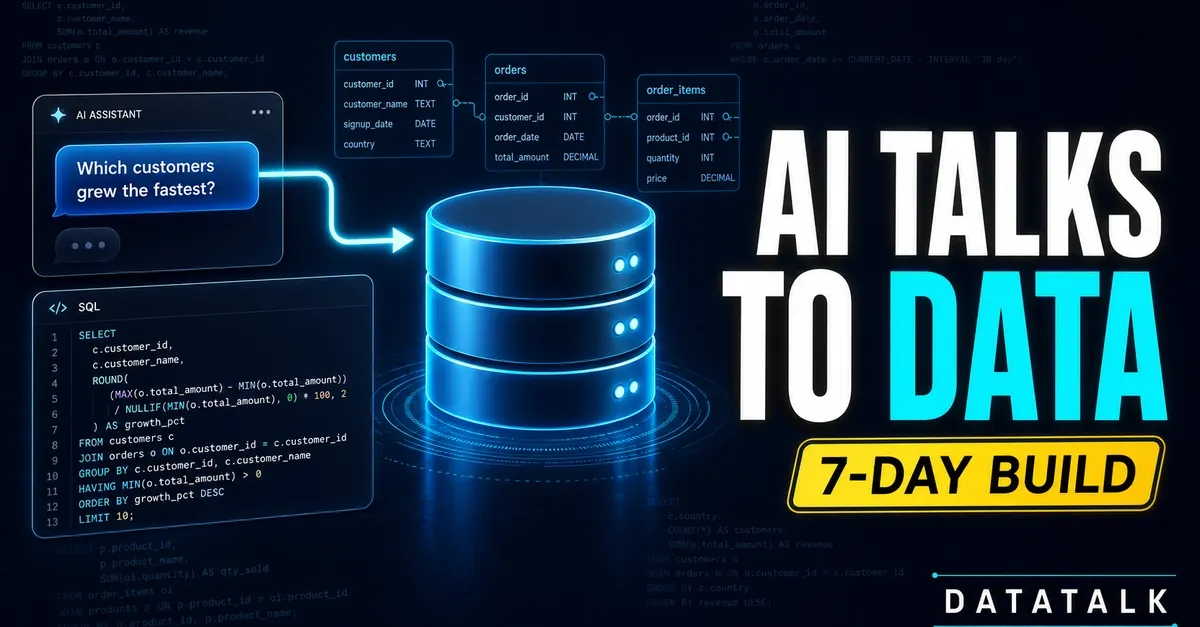
In the current landscape of artificial intelligence, many developers are focused on the "low-hanging fruit"—generating blog posts, creating images, or building simple chatbots. While these niches are crowded, a massive, high-ticket gap remains in the enterprise sector: the data translation problem.
Most modern companies do not have a shortage of data; they have a shortage of access. Business stakeholders—marketing managers, sales directors, and CEOs—frequently need specific insights, such as "Which customer segment had the highest revenue growth last quarter?" However, the answer is buried in a complex data warehouse. To get it, they must file a ticket with a data analyst, wait days for a response, and hope the metric definitions are interpreted correctly. This bottleneck creates a massive drain on productivity.
This is where the real money is made. By building a specialized AI Agent that functions as a Text-to-SQL interface, you are not just selling a tool; you are selling time and autonomy. This article outlines how to architect and monetize a SaaS (Software as a Service) product that turns natural language into reliable database queries.
The Core Problem: SQL Execution vs. Data Correctness
A common mistake beginners make when building AI tools is assuming that if a Large Language Model (LLM) can write a syntactically correct SQL query, the job is done. This is false. In a production environment, a query can run perfectly and still be fundamentally wrong.
Consider the prompt: "Show me our best-performing customers." To a human, this is ambiguous. To a database, it is impossible. Does "best-performing" mean:
- Highest total lifetime revenue?
- Highest month-over-month growth?
- Highest retention rate?
- Highest profit margin?
If your AI simply guesses, it provides "hallucinated insights" that can lead to disastrous business decisions. To build a professional-grade SaaS, your product must move beyond simple prompt engineering and into the realm of Data Engineering and complex agentic workflows.
Architecting the AI Data Agent
To solve the ambiguity problem, you cannot rely on a single prompt. You must build a multi-step workflow that mimics the thought process of a human data analyst. This is best achieved using frameworks like LangGraph, which allow you to create cyclical, stateful agent workflows.
A robust Text-to-SQL agent should follow this sophisticated lifecycle:
1. Semantic Schema Retrieval
An LLM cannot "see" an entire database at once due to context window limits and noise. Your system must first identify which tables and columns are relevant to the user's question. This requires a retrieval layer that maps natural language terms to specific schema metadata, including table descriptions and column definitions.
2. Contextual Reasoning and Metric Definition
Before writing code, the agent must resolve ambiguity. If a user asks for "revenue," the agent should check a semantic layer (often built using tools like dbt) to understand exactly which columns constitute "revenue" (e.g., gross vs. net). If the definition is unclear, the agent should be programmed to ask a clarifying question rather than guessing.
3. SQL Generation and Self-Correction
Once the context is established, the agent generates the SQL. However, instead of immediately executing it, the system should pass the query through a "validation loop." This involves checking for syntax errors or common logical pitfalls. If the database returns an error, the agent should ingest that error message, analyze what went wrong, and attempt a "self-healing" retry.
4. Execution and Interpretation
The final step is running the query within a secure, sandboxed environment with strict permission boundaries. Once the data is retrieved, the agent shouldn't just dump a raw table on the user. It should interpret the results, perhaps generating a summary or a trend analysis to provide actionable insight.
The Tech Stack for a Data SaaS
To build this successfully, you need to integrate several specialized domains. Your tech stack will likely include:
- LLM Orchestration: LangGraph is essential for managing the complex, non-linear paths an agent takes when it needs to retry a query or ask for human intervention.
- Data Transformation: Using dbt allows you to provide the agent with a "
- Database Connectivity: Support for major warehouses like Snowflake, BigQuery, or PostgreSQL is mandatory for enterprise adoption.
- Frontend/UX: A clean interface built with React or Next.js that allows users to see the "thought process" of the agent, which builds trust in the results.
Monetization Strategies: From Freelancing to SaaS
There are three primary ways to monetize your expertise in building Text-to-SQL agents:
1. High-Ticket Consulting (Upwork/Fiverr)
Many mid-sized companies are desperate to implement AI but lack the internal Data Engineering talent to do it safely. You can position yourself on platforms like Upwork as an "AI Data Architect." Instead of charging hourly, charge per project. A single implementation of a custom internal data agent can command anywhere from $5,000 to $25,000 depending on the complexity of the data warehouse.
2. The Micro-SaaS Model
3. The Enterprise SaaS Model
This is the ultimate goal: a scalable platform that connects to any enterprise data warehouse. This model relies on high-retention, high-contract-value subscriptions. Enterprise clients will pay significantly more for features like SOC2 compliance, audit logs, and granular permission controls, as these are the "safety" features that allow them to trust an AI with their proprietary data.
Conclusion
The transition from "chatting with an LLM" to "building an autonomous agent" is where the professional value lies. By focusing on the rigorous engineering required to ensure data correctness—rather than just SQL generation—you position yourself at the forefront of the next wave of AI productivity. The ability to bridge the gap between human language and structured data is one of the most valuable skill sets in the modern economy.
Before launching your product, you might want to review these real-world AI monetization case studies to refine your long-term business strategy.