Implementing Agentic AI for Autonomous Business Operations
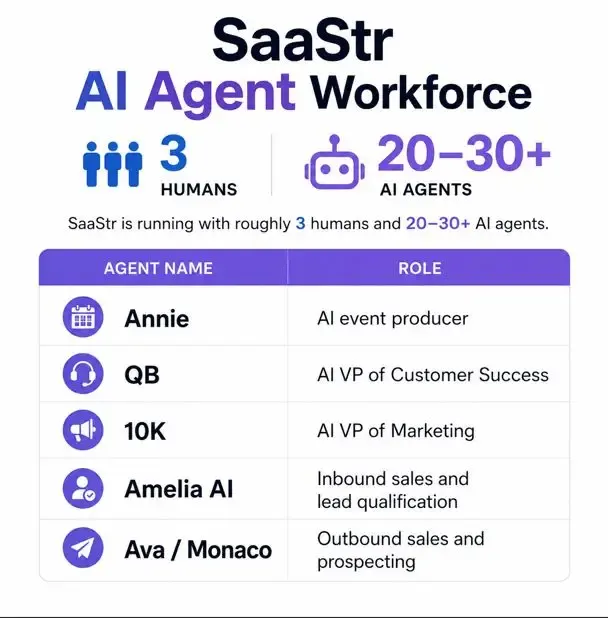
To build an autonomous business operation, you must transition from building "tools" (dashboards and scripts) to building "agents" (autonomous loops that execute tasks). This approach uses a small human core—roughly 3 people—to manage a swarm of 20+ AI agents that handle RevOps, marketing, and finance. You do not start by hiring agents; you start by automating a dashboard, and then you give that dashboard permission to act.
Who is this for and what does it cost?
This method is for established SaaS founders or small service-based agencies looking to scale operations without a linear increase in headcount. It is not for early-stage startups trying to find product-market fit, as the cost of building reliable agentic workflows is too high when your business model is still shifting.
Estimated Case Costs (Monthly):
- Compute & API usage: $200 - $1,500 (Depending on LLM token consumption for high-frequency agents).
- Software Stack: $500 - $2,000 (Salesforce, Bill.com, PandaDoc, Higgsfield, etc.).
- Human Oversight: 10–20 hours per week for a senior operator to audit "agent drift."
- Total estimated overhead: $1,000 - $4,000 per month for a highly automated mid-market operation.
How do you build an agentic RevOps workflow?
Do not attempt to build 30 agents at once. You will hit "agent sprawl," where overlapping agents provide conflicting data, making reconciliation harder than manual spreadsheets. Follow this progression:
Step 2: The Integration Phase
Connect the dashboard to your execution tools using APIs. If the agent identifies a "Closed Won" deal in PandaDoc, it should be programmed to trigger a sequence: update Salesforce, append contact details, and generate an invoice in Bill.com. Use tools like Make.com or custom Python scripts running on a cron job to manage these handoffs.
Step 3: The Autonomous Phase
Once the sequence works perfectly for 10 consecutive cycles, remove the human trigger. This is where the agent becomes "autonomous." In our case, we transitioned a marketing agent from merely suggesting ad creative to actually building and staging entire campaigns in Higgsfield, including A/B variants and audience targeting.
Where does the autonomy fail?
The most dangerous failure point is the "Confidence Gap." AI agents are designed to be helpful and assertive; they will present a hallucination or a logic error with the same tone as a verified fact. I hit a critical failure when an agent was tasked with managing vendor subscriptions. It identified a "redundant" tool and cancelled a subscription that was actually a core dependency for a legacy system, causing a 4-hour outage for our engineering team.
Common failure modes:
- Conflicting Truths: Two agents (e.g., a Sales Agent and a Finance Agent) pull data from different
- Financial Error Rates: Even a 1% error rate in invoicing is unacceptable. We found that letting an agent handle billing autonomously resulted in one incorrect invoice in a series of four. The fix is a "Human-in-the-loop" (HITL) requirement for any transaction over a specific USD threshold.
- The "Staging" Trap: Never let an agent hit "Publish" on high-stakes channels like email newsletters or paid ad spend. Agents should build, stage, and prepare the work, but a human must perform the final click.
How does this differ from standard automation?
Standard automation is deterministic; agentic automation is probabilistic. You need to understand the distinction to avoid over-engineering.
- Logic: Standard automation follows "If This, Then That" (IFTTT). Agentic automation follows "Given this goal, find the best path."
- Maintenance: Standard automation breaks when a UI changes. Agentic automation "breaks" when the logic drifts or the model's reasoning becomes inconsistent.
- Complexity: Standard automation is great for moving data between Typeform and Slack. Agentic automation is for running a full-scale Marketo-to-Salesforce migration or performing daily list hygiene on a 450,000-person database.
When should you NOT use this method?
Do not use agentic workflows for high-empathy or high-nuance tasks. If your business relies on "White Glove" customer success or complex legal negotiations, an autonomous agent will strip the value from your brand. Additionally, if your data is messy or unstructured (e.g., you don't use a CRM or your data is trapped in scattered Google Docs), the agent will spend all its compute budget hallucinating connections that don't exist.
```If you want to scale these systems, these real-world AI monetization case studies demonstrate how to implement similar agentic frameworks.