Build a Scalable AI SaaS with a Modern Tech Stack
The Modern SaaS Blueprint: How to Build Fast Without Rebuilding the Foundation
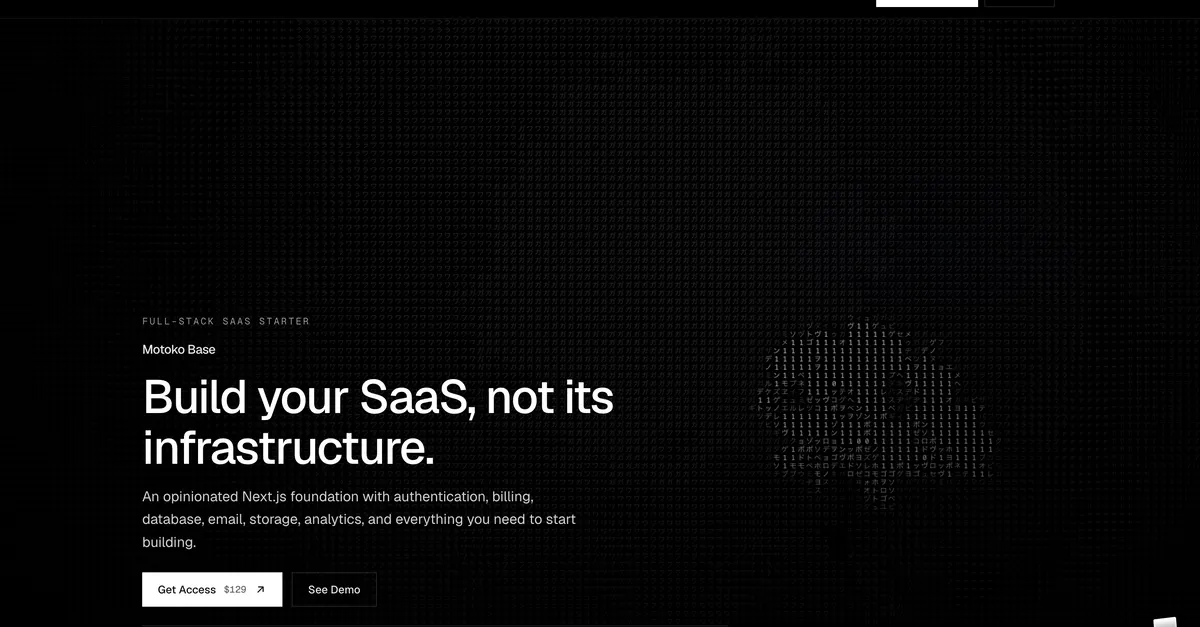
The most common trap for developers entering the world of entrepreneurship is the "infrastructure loop." You have a brilliant idea for a niche CRM, a specialized AI productivity tool, or a developer utility. You open your code editor, fueled by excitement, and begin the setup. You configure TypeScript, initialize your database, build out the authentication flows, set up OAuth, configure password resets, and implement transactional emails.
To build a successful Micro-SaaS or a large-scale enterprise platform, you must distinguish between your "Core Value Proposition" (the thing people pay for) and your "Commodity Infrastructure" (the things required to make the app function). This guide outlines a modern, high-velocity full-stack blueprint designed to get you from idea to revenue as quickly as possible.
The Strategic Tech Stack for 2025 and Beyond
A sensible baseline for a modern web-based SaaS focuses on minimizing "boilerplate fatigue." The goal is to use tools that integrate seamlessly, allowing you to focus almost entirely on your unique logic.
The Core Framework and Language
- Framework: Next.js – As a full-stack React framework, Next.js handles everything from routing and server-side rendering to server-side logic. It is the industry standard for a reason: the ecosystem is massive, and the deployment path is incredibly smooth.
- Language: TypeScript – Do not skip this. While it adds a slight initial overhead, the type safety it provides across a growing codebase prevents the catastrophic runtime errors that can sink a new startup during its first week of users.
User Identity and Security
Building your own authentication system is one of the highest-risk activities in software development. One mistake in session management or OAuth implementation can lead to a total data breach. Instead, leverage specialized tools.
- Authentication: Better Auth or Clerk – Use a library that handles sessions, OAuth providers, email verification, and account flows out of the box. You want to spend five minutes setting up a login page, not five days debugging JWT tokens.
Data Management and Persistence
Your data is your most valuable asset. You need a system that is reliable, scalable, and easy to query.
- Database: PostgreSQL – This is the gold standard for relational data. It is mature, highly extensible, and supported by every major cloud provider.
- ORM (Object-Relational Mapper): Drizzle or Prisma – These tools allow you to interact with your database using TypeScript. They provide type-safe database access, meaning if you change a column name in your database, your code will immediately show you everywhere that needs fixing.
- File Storage: Cloudflare R2 or AWS S3 – For user-uploaded images, PDFs, or large datasets, you need an S3-compatible object store. Cloudflare R2 is particularly attractive for Micro-SaaS founders due to its predictable pricing and lack of egress fees.
The Business Logic: Payments and Communication
If you are building a SaaS, you are running a business. This requires handling money and talking to your users.
- Billing: Stripe or Polar – Stripe is the undisputed king of global payments, but it comes with complexity regarding tax compliance. If you want to offload more of the administrative burden, platforms like Polar are increasingly popular for independent developers.
- Email: Resend – Transactional emails (password resets, welcome emails, invoices) must be reliable. Resend offers a developer-first API that makes sending beautiful, templated emails a tri
The AI Integration Layer
If your product involves generative AI, you must avoid "provider lock-in." If you write your code specifically for one model, you will struggle when a better, cheaper model is released next month.
- AI Implementation: Vercel AI SDK – This allows you to integrate various LLM providers (OpenAI, Anthropic, Google) into your tech stack seamlessly. It keeps your application logic decoupled from the specific model provider, giving you the agility to swap models as the landscape shifts.
Observability and Growth: Moving Beyond the MVP
Once your application is live, the challenge shifts from "making it work" to "making it scale" and "making it better." You cannot fix what you cannot see.
Monitoring and Error Tracking
When a user encounters a bug, you shouldn't have to wait for them to send an angry email. You need proactive visibility.
- Error Tracking: Sentry – Sentry captures exceptions in real-time, providing you with the exact line of code that failed and the state of the application when it happened.
- Product Analytics: PostHog – Understanding how users move through your app is vital. PostHog provides event tracking, funnels, and session replays, allowing you to see exactly where users get stuck in your onboarding flow.
Deployment and Scalability
For a modern Next.js application, the most efficient deployment path is a managed platform like Vercel. It handles the complexities of global edge networks, serverless functions, and CI/CD (Continuous Integration/Continuous Deployment) automatically. This allows you to focus on shipping features rather than managing Linux servers.
Summary: The "Build vs. Buy" Decision Matrix
To succeed in the competitive SaaS market, follow this mental model when choosing your tools:
- Build it yourself if: It is the core reason people pay you. If you are building a specialized AI video editor, build the video processing engine. That is your "moat."
- Buy/Reuse if: It is a utility that exists in a thousand other apps. Authentication, billing, database management, and email delivery are utilities. Using them allows you to reach "Product-Market Fit" months faster than your competitors.
By utilizing this full-stack blueprint, you transform from a developer who spends weeks on setup into a founder who spends weeks on value. The goal is to reach the point where you can demonstrate a working, paying product to your first customer with as little wasted effort as possible.