Build a Social Media Video Syndication SaaS with AI
Most people look at a polished social media management tool and assume it was built over a weekend: a simple login page, a basic dashboard, a few API connections, and you’re ready to launch. But if you’re looking to build a profitable SaaS in the social media space, that assumption could cost you months of work and thousands in lost revenue.
One of the most underserved, high-demand opportunities in this niche is a social media video syndication platform: a tool that lets creators and small businesses upload a single video, then automatically publish, format, and optimize it for Facebook, Instagram, TikTok, YouTube Shorts, LinkedIn, and other platforms. Solopreneurs and marketing teams waste 3 to 5 hours a week manually reuploading the same content, adjusting aspect ratios, rewriting captions, and adding platform-specific hashtags. A tool that automates that workflow saves them 10+ hours a month, and they’ll pay $29 to $99 a month for the convenience. Niche, AI-enhanced versions of these tools even command higher prices, with custom builds for enterprise clients pulling in $2,000 to $10,000 per project on platforms like Upwork and Fiverr.
The Lucrative Opportunity in Social Media Video Syndication
Why This Niche Has Low Competition and High Demand
The global social media management market is projected to hit $10.3 billion by 2028, and video content is the biggest driver of engagement across every platform. Generic tools like Hootsuite and Buffer offer basic syndication, but they lack the niche, AI-powered customization that small creators and local businesses need.
For example, a local bakery might upload a 60-second reel of a new cake, and want it automatically resized to 1:1 for Facebook, 9:16 for Instagram Reels and TikTok, and 16:9 for YouTube, with AI-generated captions tailored to each platform’s audience, relevant hashtags added, and scheduled to post at peak engagement times for each time zone. That level of automation is a huge time-saver, and there’s very little competition for affordable, AI-enhanced versions of this tool.
What Most Founders Overlook When Building a Video Syndication SaaS
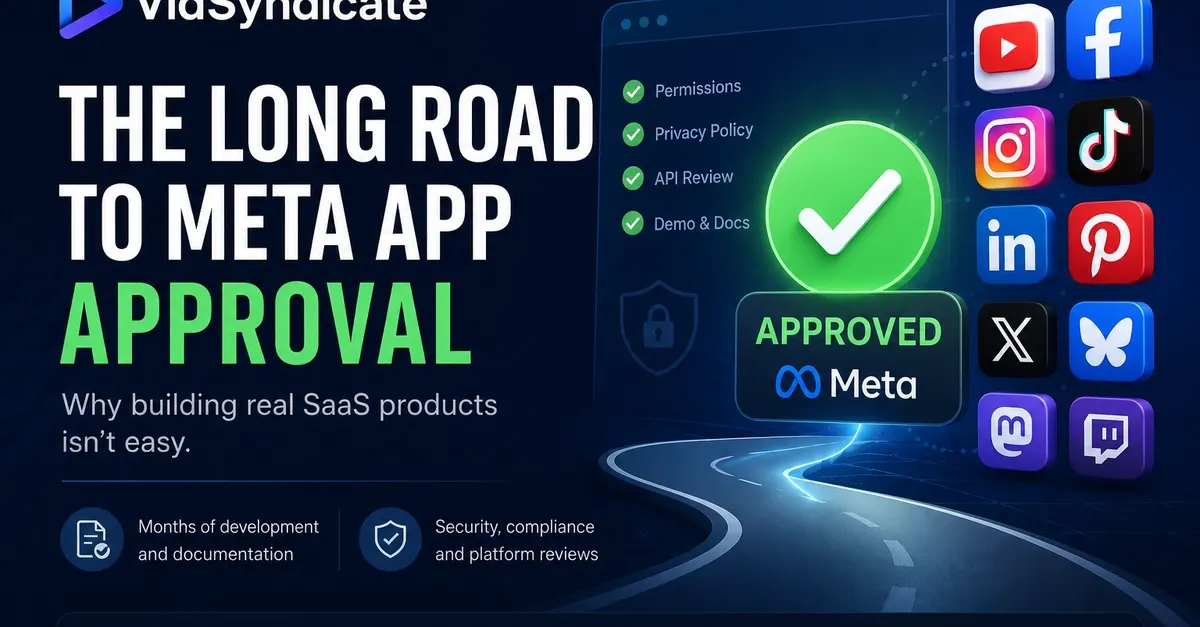
Navigating the Meta API Approval Process
- Documented justification for every single permission you request, including how each feature uses user data
- Full records of every API call your app makes, with clear explanations of their purpose
- An up-to-date privacy policy and terms of service that align with Meta’s platform rules
- Screen recordings and end-to-end demonstrations of every user workflow, exactly as it will appear to end users
- Proof that your app meets Meta’s security and compliance standards for user data
Even if your code works perfectly, you will likely go through multiple review cycles. Reviewers may request additional clarification on a workflow, or reject your submission if a feature isn’t demonstrated exactly as you described it in your application. This process can take weeks or even months, and it requires you to think like both a software developer and a compliance officer, not just a coder.
For context, the team behind a popular public video syndication tool went through 4 separate review cycles before Meta approved their app for core publishing permissions, including pages_manage_posts, instagram_content_publish, and instagram_business_manage_messages. That approval took months of documentation, testing, and revision, far longer than the initial software development phase.
Non-Flashy Features That Transform a Side Project Into a Profitable SaaS
Once you pass platform reviews, you still need to build out the backend infrastructure that makes your SaaS reliable and scalable. These features aren’t visible to users, but they’re what separate a buggy side project from a product businesses will pay for month after month:
- OAuth security and token management: You need to securely store each user’s access tokens for every connected social platform, automatically refresh expired tokens, and never expose sensitive credentials in client-side code. A single security breach will get your app banned from every platform’s API instantly.
- API rate limit and error handling: Every social platform imposes limits on how many posts you can publish per hour or per day. Your SaaS needs a built-in queue system to schedule posts without hitting those limits, and clear error notifications for users if a platform’s API is down or a post fails to publish.
- Compliance and data governance: You’ll need to build workflows for users to delete their data and revoke API access at any time, to comply with GDPR, CCPA, and other global privacy regulations. Your privacy policy needs to clearly outline how you store user videos and access tokens, and you’ll need to update it regularly as you add new features.
- Infrastructure automation and monitoring: Use serverless tools like AWS Lambda or Vercel Functions to process video uploads in the background, so your app doesn’t crash when multiple users upload large files at once. Set up monitoring with tools like UptimeRobot or Datadog to catch outages before your users notice them.
- AI-powered automation features: To stand out from generic tools, integrate AI tools like the OpenAI API to generate platform-specific captions, auto-add closed captions to videos, suggest high-performing hashtags based on content, and even trim long-form videos into short-form clips for Reels and TikTok. These features add clear value that justifies a higher subscription price.
Monetization Strategies for Your Video Syndication SaaS
Recurring and One-Time Revenue Streams
Once your SaaS is production-ready, there are multiple ways to generate consistent income:
- Subscription tiers: Offer 3 standard tiers: a Basic plan for $29/month with 3 connected platforms and 10 scheduled posts a month, a Pro plan for $79/month with unlimited posts, 10 platforms, and AI features, and an Enterprise plan for $199/month with white-label options, custom API integrations, and priority support.
- Custom build services: List custom white-label builds and niche integrations on Upwork and Fiverr. Many small marketing agencies and local business groups will pay $2,000 to $10,000 for a branded version of the tool tailored to their clients’ needs.
- Affiliate and partnership revenue: Partner with video editing tools, social media scheduling platforms, or ad management services to offer exclusive discounts to your users, and earn a commission on every referral.
The Long-Term Payoff of Building Production-Ready Software
Scaling and Exit Opportunities
The biggest lesson from building production-grade social media tools is that writing code that works is only half the battle. Building a SaaS that passes strict platform reviews, handles security and compliance, and scales with your user base is what turns a side project into a sustainable, long-term income stream.
Once you have core API integrations for Meta platforms working, you can expand to add TikTok API, YouTube Data API, and LinkedIn API over time, adding more value for your users and justifying higher price points. Many successful SaaS founders eventually sell their tools for 2 to 5 times their annual revenue, creating a large lump-sum payout on top of the recurring monthly income.
If you have experience in software development and are willing to put in the work to navigate platform reviews and compliance requirements, a social media video syndication SaaS is one of the most profitable, scalable side hustles you can build.
```To scale your content distribution, you can leverage these real-world AI monetization case studies to refine your pricing strategy.